Capurso is the other Puglia: A village that surprises you every day. With over 200 annual events and a prime location, it's the ideal starting point for exploring the region and soaking up the Apulian spirit.
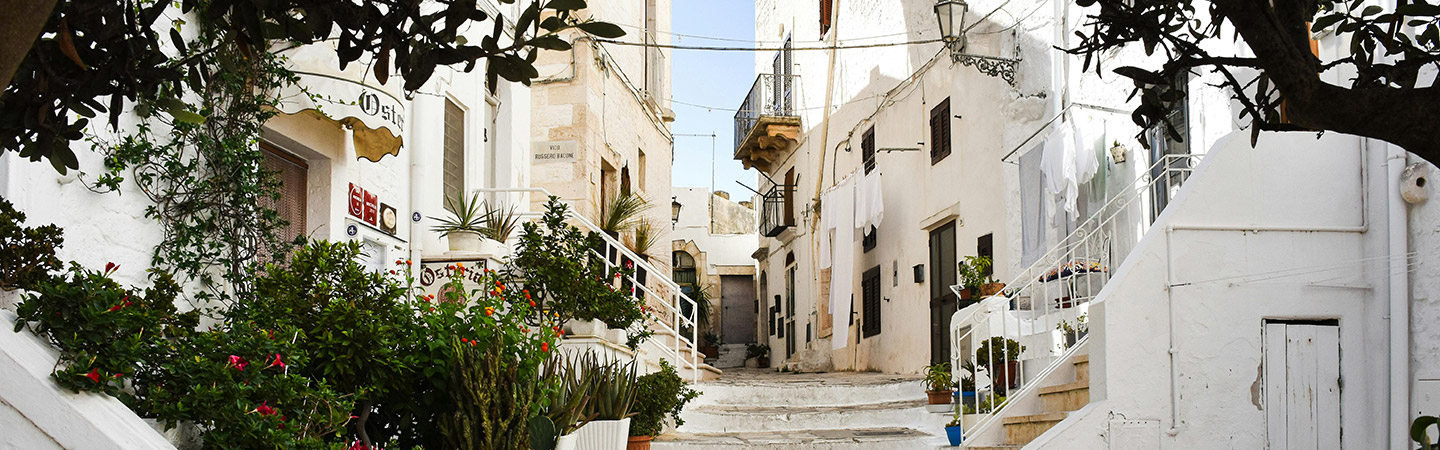
Also called “White City" Ostuni It is a place not to be missed in Puglia because it still preserves the pure white color of its houses. According to medieval tradition, the locals used to paint their houses white so that the sunlight, reflecting on the white walls, could blind enemies arriving from the sea. In the 1600th and 1800th centuries, whitewash was an administrative requirement because it was used as a natural disinfectant against the plague that was affecting the area. The fact remains that walking through the narrow streets of Ostuni It is fascinating and gives the impression of becoming for a moment the shepherd of a real nativity scene. Worth visiting is the Cathedral of Santa Maria dell'Assunzione, in Gothic style and the Convent of the Nuns which hosts archaeological exhibitions.
Cisternino It is considered one of the most beautiful villages in Italy, a jewel of Italy, a slow city, Orange Flag of the Italian Touring Club, green flag and city of peace! According to legend, the name Cisternino would derive from Sturnino, the name given to this city founded by Sturnio, a companion of Diomedes (founder of Brindisi), who escaped the Trojan War. Another hypothesis is that the name derives from Cis-sturnium, that is, “beyond Sturnium“, the current Ostuni. The historic center of Cisternino It is characterized by typical white buildings with terraces full of bougainvillea. The Mother Church of San Nicola Built in the 14th century on an ancient early Christian church of the Benedictine monks. Inside it features a Madonna and Child (Madonna del Cardellino) and a tabernacle by Stephanus Abulie Poteniani (Stefano da Putignano) and a pipe organ made by Cav. Pacifico Inzoli of Crema (CR) dating back to 1909. Another place not to be missed is the Sanctuary of the Madonna d'Ibernia or Madonna De Bernis.
La Valle d'Itria it is a karst depression that extends between Locorotondo, Cisternino and Martina Franca, coincides with the southern part of the Murge plateau. It is characterized by the presence of trulli e historic farms. The trulli they are typical and exclusive cone-shaped stone dwellings, mostly found in Alberobello. The historic farms Instead, they are farmhouses built from local stone, typically rectangular in shape with an open space in the center and rooms along the perimeter. Formerly used by farmers as homes and workplaces, today masserie are a green-luxury alternative to hotels. Inside the masseria, you can experience Apulian culture to the fullest without sacrificing comfort and pampering. The Itria Valley is also known as the Valley of the Trulli and includes towns such as Alberobello, Cisternino, Locorotondo, Martina Franca, Ceglie Messapica and Ostuni.
DISTANCE FROM CAPURSO: 60 KM – 1H